








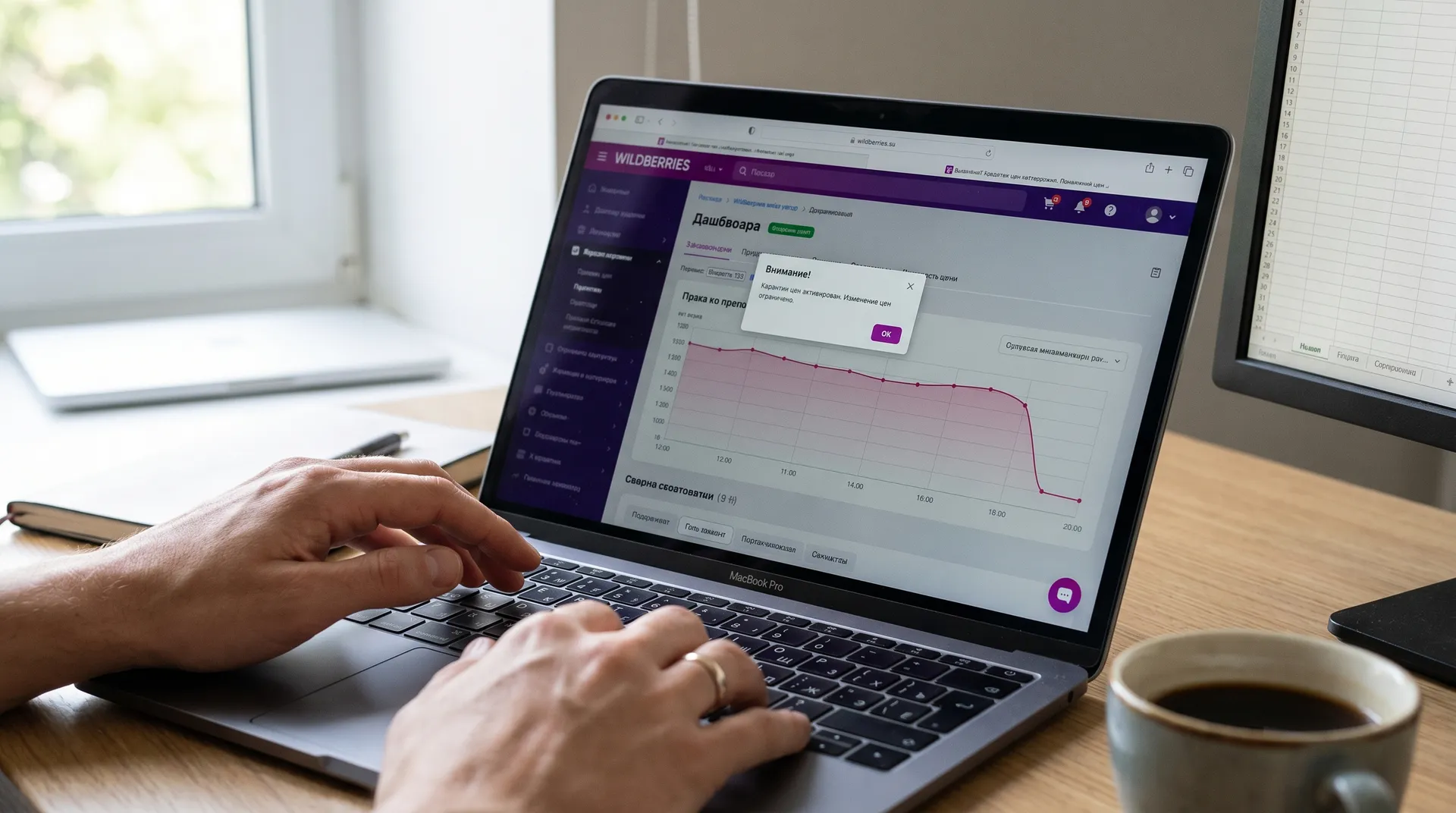
The Wildberries price quarantine mechanism appeared quietly — without loud announcements. Sellers began to notice it in their personal account: when they tried to reduce the price by more than 1.5 times, the card switched to the waiting status.
How quarantine works
The trigger threshold is 33.3%. If the price decreases less, the change is applied immediately. If there is more, the card goes to be checked, and the new price "hangs" until it is completed. Wildberries does not disclose the timing of the verification.
The formal purpose of the mechanism is to protect against dumping and price manipulation. For buyers, this means fewer "fictitious stocks", when the price is first artificially raised, and then demonstratively reduced.
What does this mean for sellers
For most common situations, quarantine does not interfere: planned discounts of 10-20% are carried out without delay. The problem occurs in two cases.
The first is currency fluctuations. The importer buys the goods in Chinese yuan or dollars. With a sharp weakening of the ruble, you need to quickly adjust the price upward, then just as quickly return it to its previous level when it stabilizes. If the correction exceeds 33%, both movements may be quarantined.
The second is the elimination of runoff. When you need to quickly sell off the leftovers before a new delivery, a sharp price reduction is a standard tool. This action will now be delayed.
Ozon is testing the separation of reviews
In parallel, Ozon is conducting an experiment — until May 19: dividing reviews by product options. Currently, all variants of the same card (different colors, sizes) have a common rating. After the change, each option will get its own.
This can be painful for sellers: new product options will lose their head start from the overall accumulated rating. From the buyer's point of view, it's more honest, because a review of a white sweater should not affect the rating of a black one.
Practical actions
To review the strategy for eliminating runoff is to lay down the price reduction in stages, not exceeding the threshold of 33% per change. Plan price ranges in advance when dealing with volatile currencies. On Ozon— evaluate cards with multiple options and understand which options will be at risk when dividing reviews.